R2R
Released-to-Real
R2R

Released Models,

Real Vehicles

Beyond the benchmark: localizing released driving models to the vehicle they actually drive

Released Planner.

Collision.

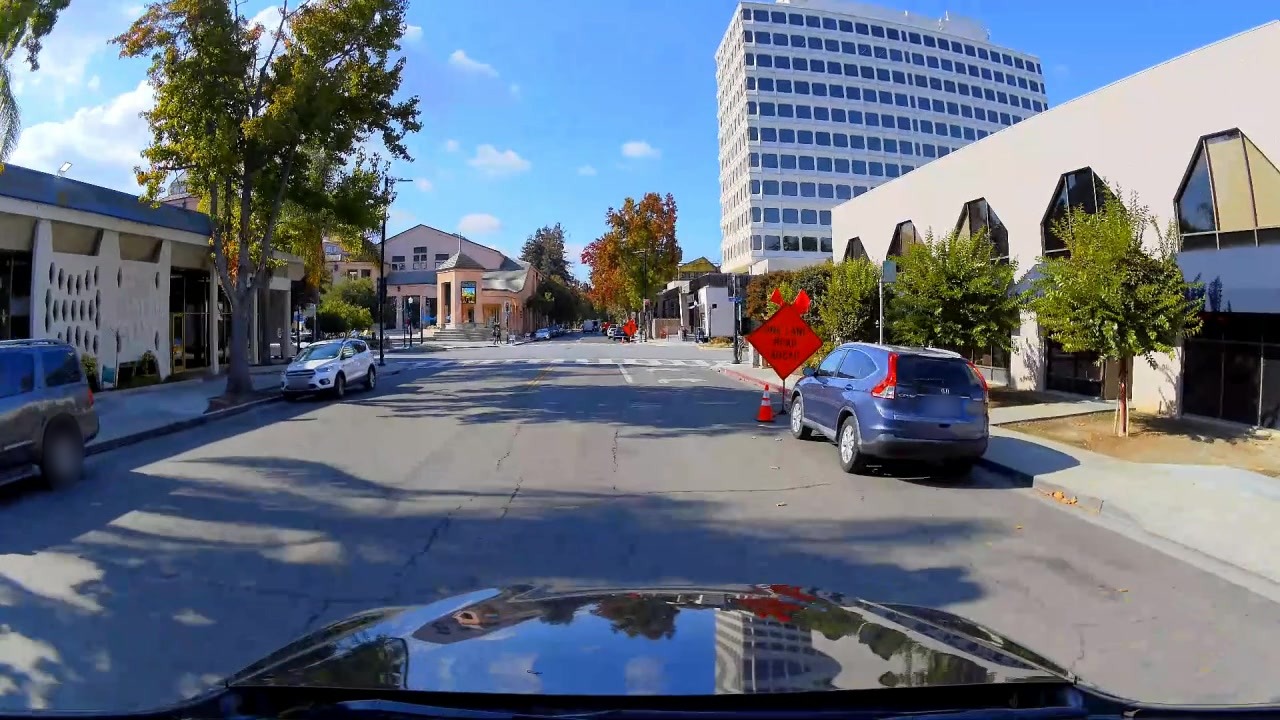
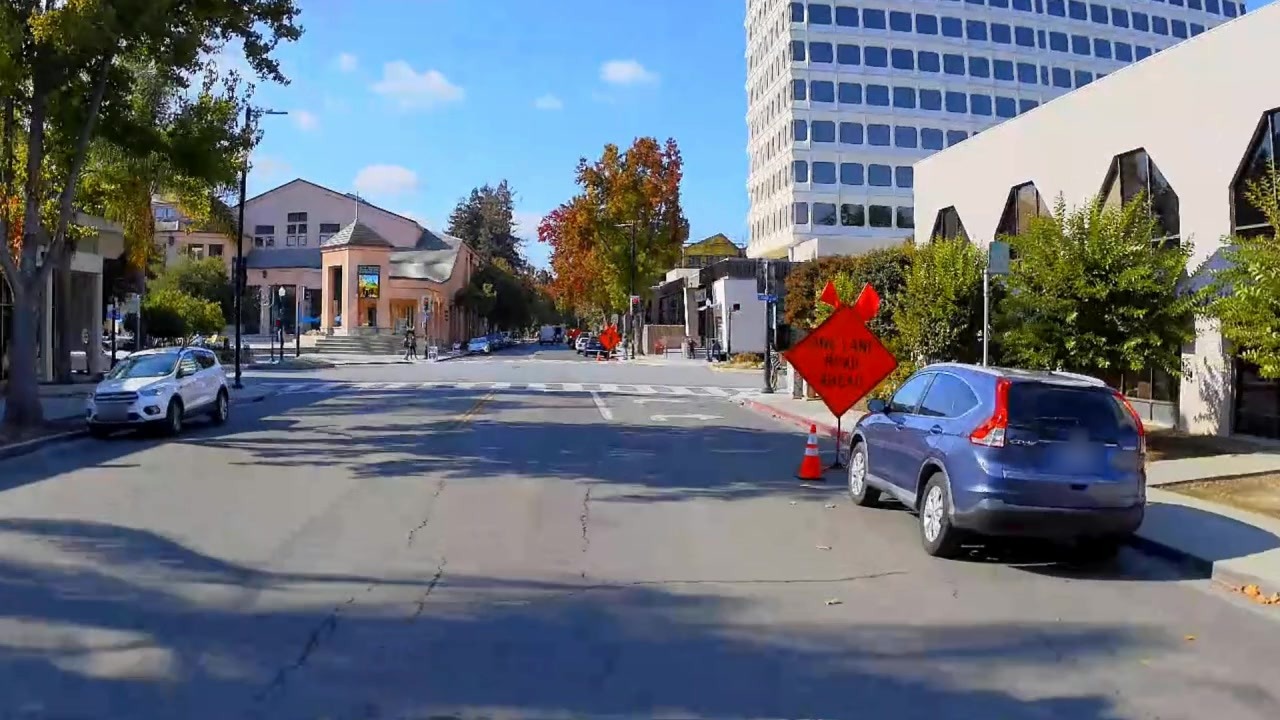
Closed loop in a twin of the real street: the released planner cuts the turn into the parked truck.

Localize the Coupling.

Correct Only What Breaks.

HA-RL on ordinary driving logs · closed-loop success 82.2% → 95.2%

✕ Released · collision
✓ R2R · passes the truck
REALour vehicle · front camera
Scroll to explore

R2RReleased-to-Real Beyond the Benchmark: Localizing Released
Autonomous Driving Models to Real Vehicles

Morui Zhu, Deyuan Qu, Qi Chen, Qing Yang
82.2%→95.2%
closed-loop success of a released diffusion-based planner after HA-RL
19×
cheaper rollouts than generative closed-loop RL (0.9 s vs 17 s), with no world model
0.041→0.420
vehicle mAP of a released multi-camera detector on a five-camera rig, weights frozen
0 target labels
for the sensor corrections: calibration and ordinary driving only, on three real rigs

Strong on the Benchmark, Broken on a New Vehicle

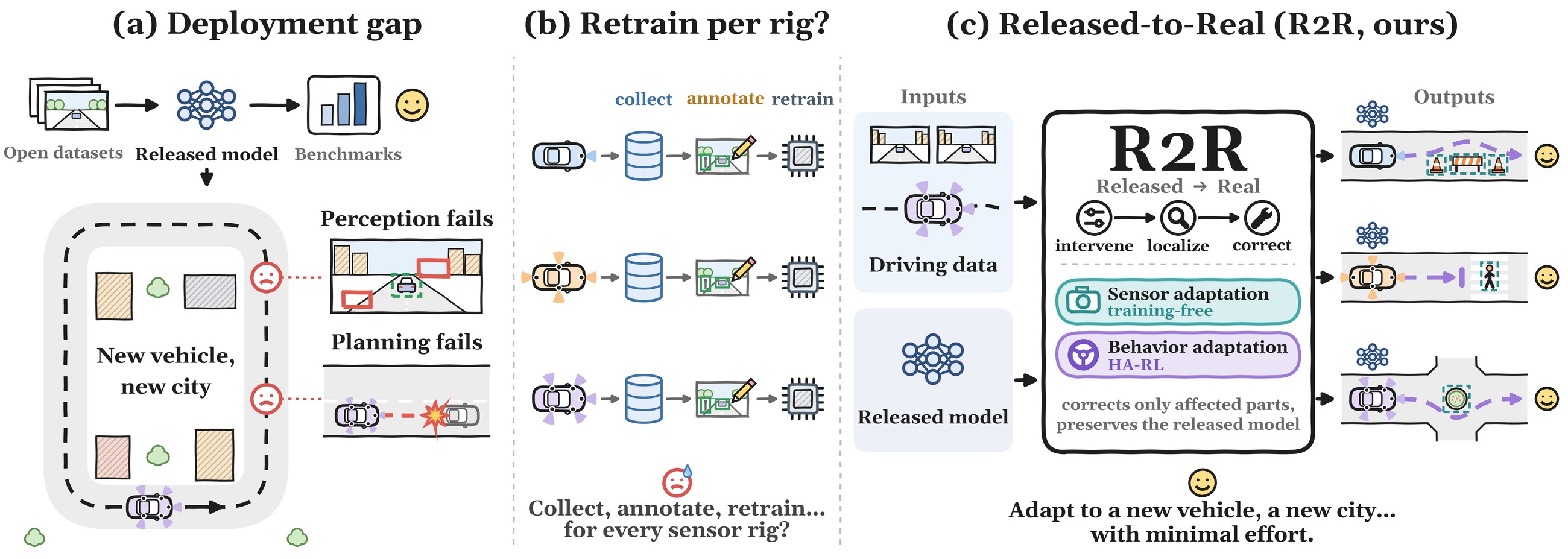
Open datasets and released models have made strong driving perception and planning widely accessible, yet a strong benchmark score does not make a released model ready for a real vehicle. Differences in sensor configuration, data distribution and execution process can invalidate what the model learned on its source system — and they persist even after the obvious adaptation is done.

R2R takes a released model and ordinary driving from the target vehicle, localizes what remains coupled to the source system by controlled intervention, and corrects only that part.

R2R overview
(a) A released model that scores well on benchmarks fails in perception and planning on a new vehicle in a new city. (b) Retraining would require collecting and annotating data for every sensor rig. (c) R2R localizes what remains coupled to the source system and corrects only that part: sensor adaptation with frozen weights and behavior adaptation with Human-Anchored RL (HA-RL).

Higher Open-Loop Score, Lower Closed-Loop Success

Conventional post-training — imitation learning followed by RL with a trajectory-level driving score — raises the planner's open-loop score from 0.698 to 0.809, the highest of all variants. In closed loop its success rate falls from 82.2% to 78.1%, and collisions rise from 4.4% to 12.2%.

Open-loop score vs. closed-loop success

Post-training variants of the same released planner on our downtown benchmark (90 closed-loop events)
Closed-loop success rate (%)Open-loop RPDMS

Why: the first planned segment runs fast

How much faster the first planned segment is than the input speed (m/s), probed on fixed frames
The trajectory reward barely registers this offset: making the first segment of the human trajectory 1 m/s faster changes its score by < 0.001. In closed loop, every replan executes it again.

One Methodology: Intervene → Localize → Correct

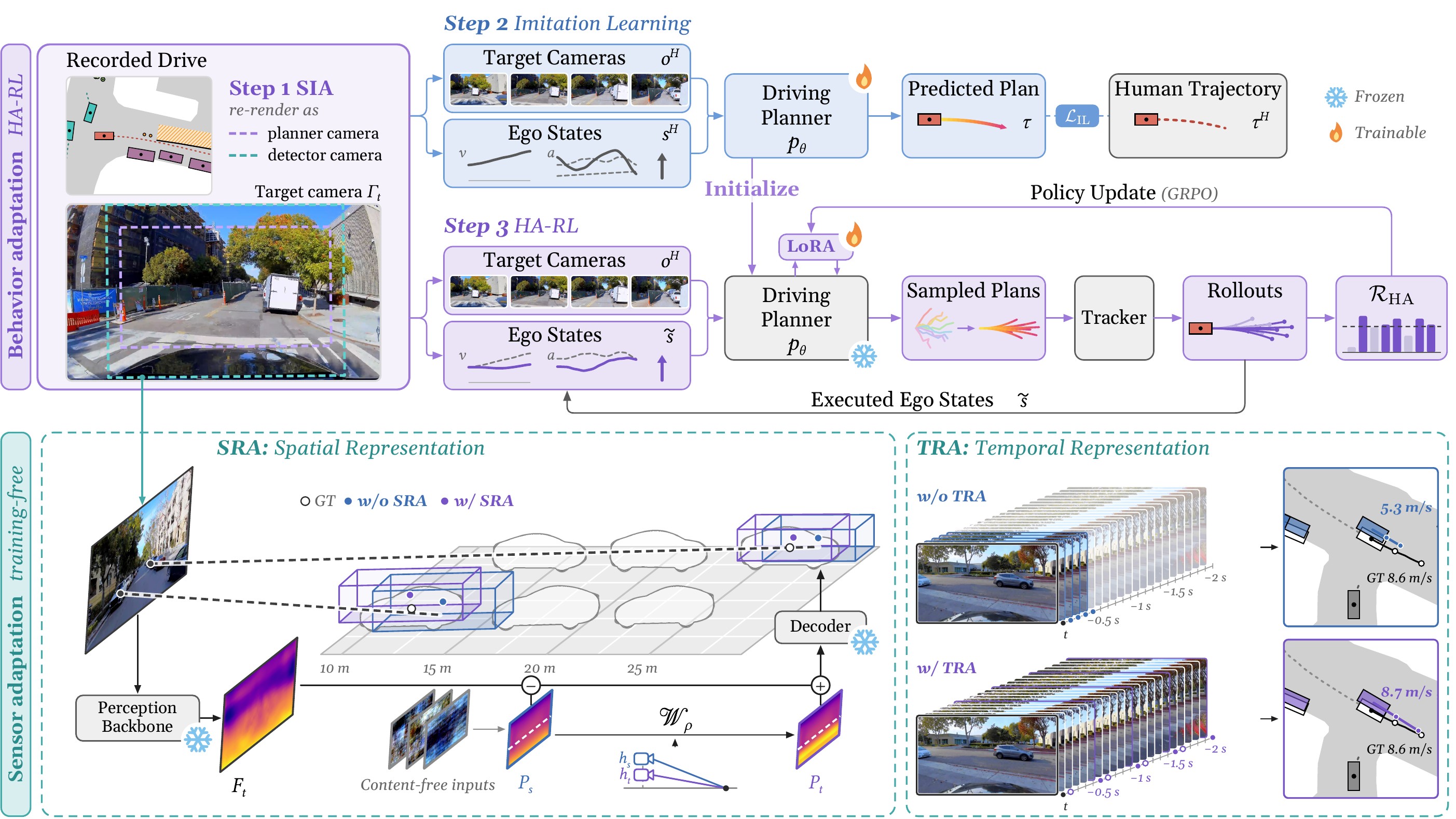
R2R varies one deployment variable while holding the remaining inputs, representations or parameters fixed, localizes the source dependency, and corrects only the affected objective, interface or representation. Both halves start from the same step: sensor-interface alignment (SIA) re-renders the recorded target cameras as the cameras each model was trained with.

R2R method
Top, behavior adaptation: SIA, imitation learning on target driving, then HA-RL — the ego state follows the planner's own execution through a tracker on recorded observations, and the reward anchors it to human behavior. Bottom, sensor adaptation (training-free): spatial representation alignment (SRA) re-weights the source spatial prior of the frozen detector, and temporal representation alignment (TRA) restores the source frame interval in its temporal memory.

Show the Model the Camera It Was Trained With

raw target camera re-rendered planner camera
TARGET CAMERARE-RENDERED · PLANNER CAMERA

Our front camera is wider, mounted differently and sees the hood. SIA re-renders every frame into the intrinsics and pose of the camera the released model was trained with, using only the calibrations. Drag the slider.

0.691open-loop RPDMS of the released planner with SIA, from 0.623 on the raw camera — same weights 0.200vehicle mAP of the released detector on rig C with SIA alone, from 0.041

HA-RL: 95.2% Closed-Loop Success

The mismatch enters through the ego state, not the observation. Letting the ego state alone follow the planner's execution — on recorded target frames — recovers the closed-loop gain of generative closed-loop RL, without generating a single frame.

re-rendered input
Step 1: re-render target cameras
(weights unchanged)
ordinary target driving
Step 2: imitation learning on ordinary target driving
(OL 0.698 → 0.784, stalls 10.0% → 0%)
Step 3: HA-RL, ego state follows execution
(SR 84.4% → 95.2%, 0.9 s / rollout)

What follows the planner's execution?

Three RL variants from the same IL model — closed-loop success rate (%)

Cost per rollout on the same GPU

Seconds; generative rollouts are dominated by video generation

Released vs. R2R, Same Event, Same Start

After HA-RL, we validate the localized planner in a generative closed loop where both the ego state and the front-camera observation evolve with the policy. Each event runs for 4 s with replanning every 0.53 s, starting from the same real frame.

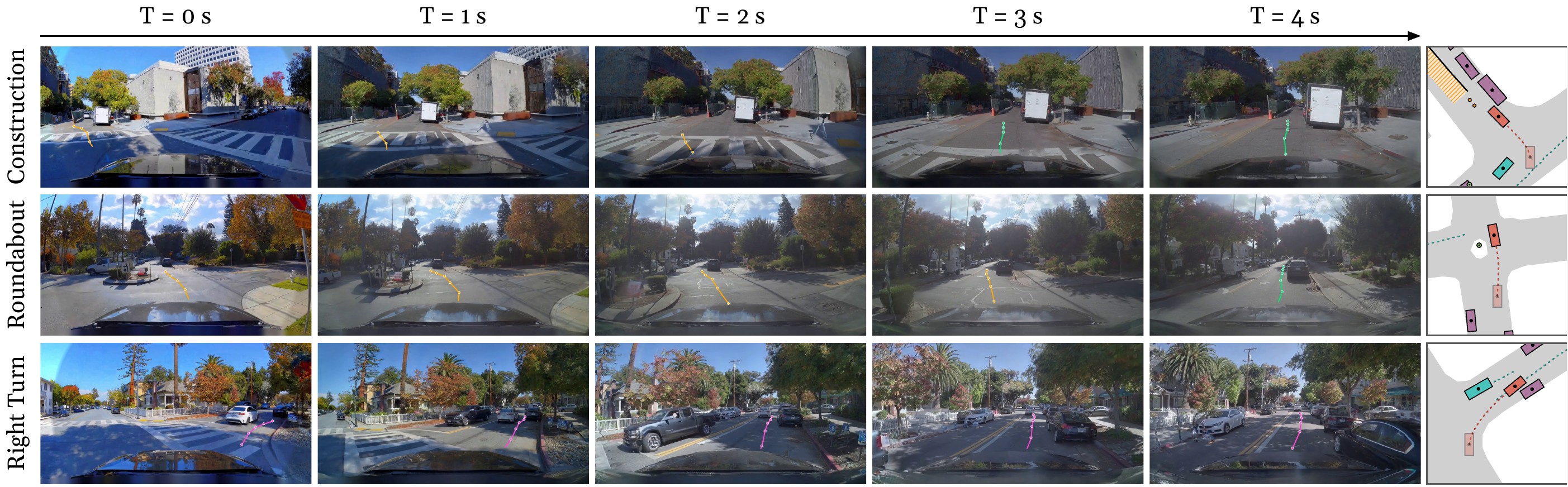
Construction zone

The released planner cuts the turn into the parked truck; R2R slows and passes.
✕ Released · collision
✓ R2R (HA-RL) · success
✕ Released
✓ R2R
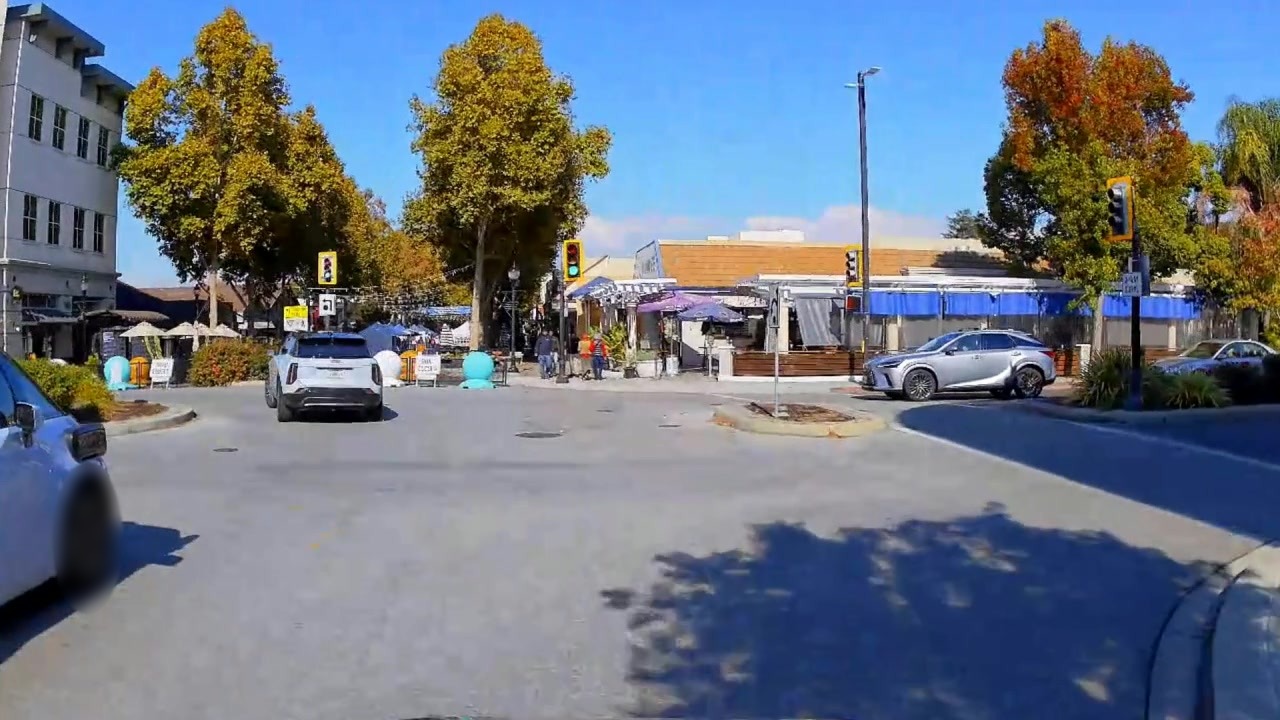
Pedestrian crossing · released planner stalls
✕ Released
✓ R2R
Crosswalk with pedestrians · released planner stalls
✕ Released
✓ R2R
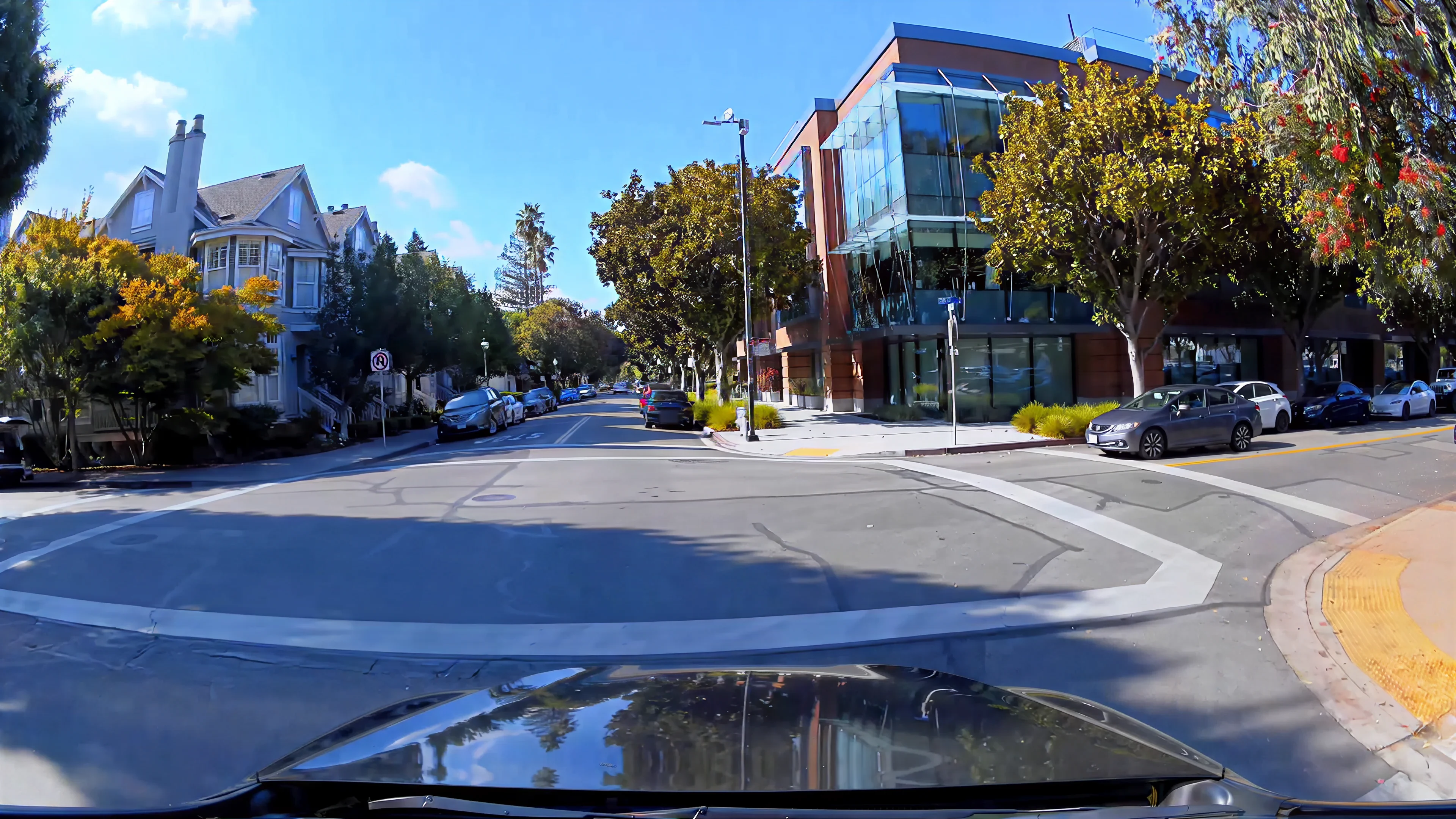
Turn · released planner leaves the road
qualitative planning
Qualitative results after post-training in three scenes: construction, roundabout, and right turn at an intersection. Each row shows the predicted trajectory on the generated frames of the closed loop and the top view at the end of the event.

Post-Training Results

TrainingOL ↑SR ↑Coll. ↓Off ↓Rule ↓Stall ↓
Released0.69882.24.43.30.010.0
IL0.78484.47.82.25.60.0
IL + RL, trajectory reward0.80978.112.21.98.90.0
IL + RL, generative closed loop0.77993.01.51.90.03.7
IL + HA-RL (R2R)0.78595.21.91.50.01.5
Execution reward alone
94.4%
Replacing the trajectory reward by the execution reward raises SR from 78.1%; the human anchor keeps OL at the IL level and reaches 95.2%.
IL first
84.8%
The same RL stage on the released model reaches 84.8% with HA-RL (62.6% with the trajectory reward) — IL on target driving is needed first.
Public benchmark (NAVSIM)
53.9% → 90.9%
Repeating IL and HA-RL on NAVSIM with EPDMS in the rewards; collisions fall from 4.4% after IL to 2.8%.

Frozen Weights, 10× Vehicle mAP

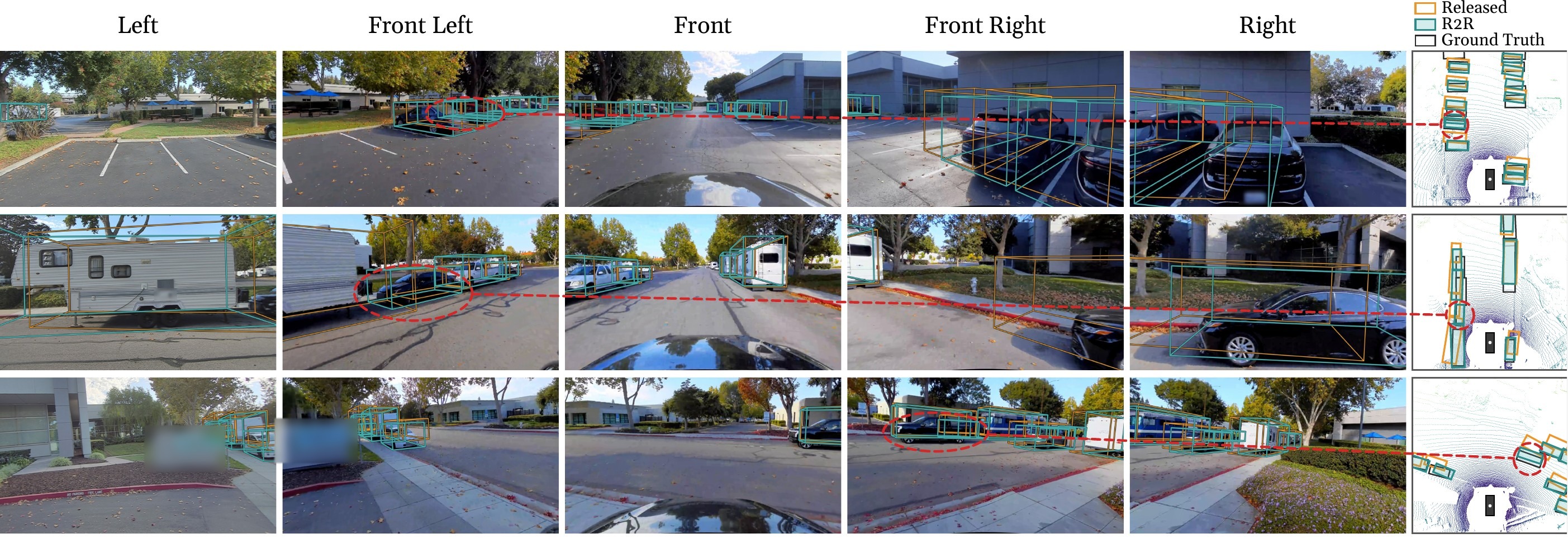
Released detectors keep source-sensor spatial and temporal priors even when the correct target calibration is supplied. Probes with fixed image content show where the training rig resides; R2R corrects exactly those representations from calibration — no target annotations, no gradient updates, one fixed setting per detector for all rigs.

Vehicle mAP on our three real rigs, public nuScenes weights frozen

Alignment steps added in turn
Rig C, five cameras
0.041 → 0.420
SIA gives the first large gain (0.200); TRA adds as much again.
All rigs
0.40–0.49
Vehicle mAP after R2R: 0.40–0.48 for the position-embedding and 0.45–0.49 for the anchor-sampling detector.
Unmodified vehicle-stack node
0.204 → 0.477
The driving stack's own detector node, unmodified, replayed on the five-camera drive.
qualitative detection
Detections of the released and the R2R-corrected detector on our rigs, with frozen public weights.

Better Boxes, Fewer Crashes 16 Seconds Later

The same planner (PDM-Closed) drives 16 s in closed loop from the same recorded start on our downtown drive, replanning every 0.5 s. Only its object input changes: the boxes of a released detector with direct transfer, or with R2R. Other road users follow the recording. Pick a scene, drag the timeline, or switch the view.

Detector
Direct transfer R2R GT boxes as input Recorded human drive Road users
t = 0.0 s
loading scene…
0481216 s

Direct transfer
R2R
GT boxes
Direct transfer boxes on the recorded front camera
R2R boxes on the same frame · dashed: the object the direct-transfer ego hits

At-fault collisions in 16 s closed loop, 2,132 events

Direct transferR2RGT boxes
The scenes are events where PDM-Closed collides on direct-transfer StreamPETR boxes and drives the full 16 s on R2R boxes and on GT boxes. Over all 2,132 events, R2R lowers the collision rate of PDM-Closed for every detector, and of Diffusion Planner for the two detectors trained on nuScenes. The detectors run on the recorded camera frames, so the boxes follow the recording while the simulated ego can drive ahead of it.

No Retraining, Still Ahead of Retrained Methods

On nuScenes → Waymo and nuScenes → Lyft in the protocol of CoIn3D, R2R keeps the public nuScenes weights frozen. It gives the single-frame position-embedding detector a higher NDS* than CoIn3D obtains for the same detector with retraining, and the anchor-sampling detector exceeds every retrained method on Lyft.

NDS* of the single-frame position-embedding detector

Direct transfer (no retrain)CoIn3D (retrain)R2R (no retrain)

Abstract

Released autonomous-driving models achieve strong benchmark performance, yet deploying them on a new real vehicle remains challenging. We study this deployment gap and find that released models can remain coupled to assumptions from their source sensing, data, and execution processes even after conventional adaptation. We introduce Released-to-Real (R2R), a deployment-localization methodology that identifies such source-system coupling and corrects only the affected components while preserving the released model. For data and behavior adaptation, we find that the mismatch between trajectory-level optimization and receding-horizon execution enters through the ego state rather than the observation, and introduce Human-Anchored Reinforcement Learning (HA-RL), which corrects it on recorded target driving without the costly rollouts of generative closed-loop reinforcement learning (RL). For physical sensor adaptation, R2R localizes and corrects source-dependent spatial and temporal representations with frozen perception weights, requiring neither target annotations nor retraining. HA-RL improves the closed-loop success rate of a released diffusion-based planner from 82.2% to 95.2%, while sensor adaptation across multiple released detectors and three real sensor rigs improves the vehicle mean average precision (mAP) of a released multi-camera detector from 0.041 to 0.420 on a five-camera target rig. These results provide a practical path for preparing released models before deployment on new real vehicles.
Citation

@article{zhu2026r2r,
  title   = {Beyond the Benchmark: Localizing Released Autonomous Driving Models to Real Vehicles},
  author  = {Zhu, Morui and Qu, Deyuan and Chen, Qi and Yang, Qing},
  journal = {arXiv preprint},
  year    = {2026}
}
About this page